
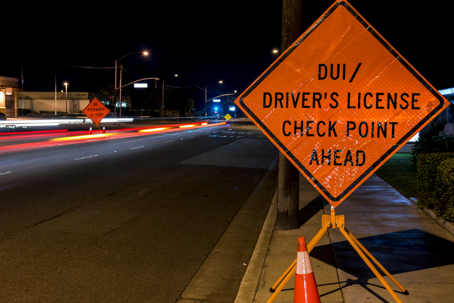
Summer is prime time for DUI enforcement in Alabama. Holiday weekends, outdoor events, and increased nighttime traffic put more law enforcement officers on the roads, including at sobriety checkpoints. If you plan to drive in Birmingham or anywhere across the state this season, understanding how DUI checkpoints work under Alabama law can make a real difference in how you respond if you are ever stopped.
This post covers the legal framework behind Alabama DUI checkpoints, what drivers are required to do, what law enforcement must do to conduct a lawful stop, and what can happen to a case when those requirements are not met.
Are DUI Checkpoints Legal in Alabama?
Yes. Sobriety checkpoints are legal in Alabama under both state law and U.S. Supreme Court precedent. In Michigan Department of State Police v. Sitz (1990), the Supreme Court held that the public safety interest in reducing drunk driving outweighs the limited intrusion on individual liberty that a brief checkpoint stop represents.
However, that ruling did not give law enforcement unlimited authority. Alabama courts and the U.S. Constitution still require that checkpoints meet specific legal standards. When those standards are not met, the checkpoint and any evidence gathered at it may be legally vulnerable.
How DUI Checkpoints Must Be Conducted in Alabama
Alabama law and constitutional principles require that sobriety checkpoints follow established procedures to be valid. Courts evaluating checkpoint legality look at several key factors:
The checkpoint must be authorized by supervisory law enforcement
Officers in the field cannot decide on their own to set up a DUI checkpoint. The checkpoint must be authorized and planned by supervisory personnel, not left to the discretion of individual officers at the scene. This limits arbitrary stops and protects drivers from being singled out based on an officer's personal judgment.
The location and procedure must be decided in advance
The location of the checkpoint, the time it will operate, and the method for selecting which vehicles to stop must all be determined ahead of time using neutral criteria. Law enforcement cannot arbitrarily pull over certain cars while waving others through based on subjective factors.
There must be some level of public notice
Alabama courts have recognized that advance notice to the public, such as announcements in local media or online, is a factor that supports the constitutionality of a checkpoint. While this does not require that the specific location be publicized in detail, some form of general notice to the public is expected.
Stops must be brief and minimally intrusive
The purpose of a checkpoint stop is to briefly assess whether a driver shows signs of impairment. Officers are not permitted to conduct an extended detention simply because a driver is at a checkpoint. If nothing during the initial contact suggests impairment or a violation, drivers should be allowed to proceed.
What Are Drivers Required to Do at a DUI Checkpoint?
If you are stopped at a sobriety checkpoint in Alabama, here is what you are generally required to do:
- Stop when directed by law enforcement.
- Provide your driver's license, vehicle registration, and proof of insurance when asked.
- Remain in your vehicle unless instructed otherwise.
What you are not required to do is equally important. You are not required to answer questions beyond providing identifying documents. The Fifth Amendment protects your right to remain silent. You do not have to answer questions about where you have been, where you are going, or whether you have been drinking. You can politely decline to answer and invoke your right to remain silent.
You also cannot be detained for an extended period simply because you declined to answer questions or appeared nervous. If an officer has no reasonable basis to believe you are impaired, the stop should end quickly.
Can You Turn Around to Avoid a Checkpoint?
This is one of the most common questions about DUI checkpoints. In Alabama, you are generally permitted to make a legal turn to avoid a checkpoint, provided that turn is made legally and without any traffic violations. If you signal properly and make a lawful turn well before the checkpoint, the act of turning around alone is not sufficient grounds for a traffic stop.
However, if an officer observes a traffic violation such as failure to signal, an illegal turn, or erratic driving, that creates an independent basis for a stop. The key distinction is between legally avoiding a checkpoint and committing a separate violation in the process.
Field Sobriety Tests and Breathalyzers at Checkpoints
Field sobriety tests
Field sobriety tests, including the walk-and-turn, one-leg stand, and horizontal gaze nystagmus, are not mandatory in Alabama. Drivers are not required to submit to standardized field sobriety tests. These tests are voluntary, and declining them is not itself a criminal offense. That said, refusal may be noted and could factor into how an officer proceeds.
Chemical tests (breathalyzer and blood tests)
Alabama has an implied consent law. By driving on Alabama roads, you have legally consented to chemical testing if a law enforcement officer has probable cause to believe you are impaired. Refusing a chemical test after a lawful arrest carries its own consequences, including an automatic license suspension and the fact that your refusal can be used against you in court.
It is important to understand the difference between the pre-arrest portable breath test, which you are not required to take, and the post-arrest chemical test administered at the station or by a certified officer, which triggers implied consent consequences if refused.
When Can Checkpoint Evidence Be Challenged?
Not all DUI cases that begin at a checkpoint are airtight. If the checkpoint itself was not conducted lawfully, evidence gathered there, including observations of impairment, field sobriety test results, and chemical test results, may be subject to suppression. Common grounds for challenge include:
- The checkpoint was not authorized by supervisory personnel
- Vehicles were selected for stops based on officer discretion rather than neutral criteria
- The checkpoint lacked any advance public notice
- The stop lasted significantly longer than necessary for a brief assessment
- The officer lacked reasonable suspicion or probable cause before extending the stop
A successful suppression motion, arguing that evidence was obtained unlawfully, can significantly affect the course of a DUI case. The strength of any challenge depends heavily on the specific facts of the stop and the procedures followed by law enforcement.
What to Do If You Are Charged with DUI After a Checkpoint Stop
If you were stopped at a checkpoint and are now facing a DUI charge in Alabama, the steps you take immediately after the arrest matter. Avoid making statements to law enforcement beyond what is legally required. Do not discuss the facts of your case with friends, family, or on social media. And contact a criminal defense attorney as soon as possible.
An experienced Birmingham DUI attorney can review the specific circumstances of your stop, evaluate whether the checkpoint met Alabama's legal requirements, assess the evidence against you, and develop a defense strategy tailored to the facts of your case. Early legal representation can make a meaningful difference, particularly in cases where checkpoint procedures may be vulnerable to challenge.
If this is your first DUI offense, you may have options that are not available if you wait. Alabama law provides certain first-offense pathways that require prompt action and the right legal guidance.
Facing a DUI Charge This Summer? Do Not Wait.
A DUI charge is serious, but it is not an automatic conviction. If you were stopped at a checkpoint and charged with DUI in Alabama, contact Revill Law Firm today for a free consultation. Our team is available 24/7 and is committed to fighting for your rights at every stage of the process.